 Why
Why
- The Claim Under Examination
- What the Fine Print Actually Says
- The 80% Problem
- Coanda and Thick Hair
- The 40-Minute Routine
- The Attachment Tax
- The Cord
- Who This Works For
- Better Alternatives
- The Information Gap the Marketing Does Not Address
Dyson calls the Airwrap Multi-Styler a device that gives you "effortless" styling with "faster results." Those two words appear together frequently in Dyson's retail and social marketing. "Effortless" is the aspiration. "Faster" is the functional promise. These are the claims I want to examine.
Not emotionally. Precisely.
The Claim Under Examination
Dyson's marketing language for the Airwrap centers on a specific idea: that the device removes the effort from hair styling. The Coanda airflow principle — a fluid dynamics mechanism in which moving air attaches to a curved surface and draws material along with it — is the engineering basis for this claim. Hair wraps around the barrel automatically. No pins, no manual wrapping, no heat damage from direct plate contact. The promise is that the technology does the work.
"Effortless" and "faster" are companion claims. Faster than what? Faster than a conventional blow-dry-plus-curling-iron combination. This is the baseline Dyson establishes implicitly in its marketing materials.
I want to test both claims against what the device actually requires.
What the Fine Print Actually Says
Dyson's own product documentation includes an acknowledgment that "results vary by hair type." This sentence is precise and worth reading carefully. It is not a generic disclaimer. It is a statement about the Coanda effect — the mechanism on which the entire device's value proposition depends.
Coanda airflow works best on fine to medium hair textures. The physics are not contested: finer hair is drawn to the barrel by the airflow with greater consistency. Thicker, coarser, or more tightly coiled hair resists the airflow initiation more frequently. Dyson knows this. They say so, in the fine print.
The marketing does not feature the fine print demographic. It features a specific hair type having a specific experience. And.
The majority of buyers are not reading the fine print before purchasing a $599 device.
The 80% Problem
The Airwrap does not operate on wet hair. This is not a minor operating condition — it is the device's fundamental usage constraint. Dyson specifies that the Airwrap works on hair that is approximately 80% dry. Wet hair will not cooperate with Coanda initiation. The physics require a specific moisture level to function.
What this means in practice: before you begin styling, you must pre-dry your hair. Entirely separately from the Airwrap. With a conventional dryer, a towel, or the Airwrap's own blow-dry attachment — which requires swapping attachments and completing a partial-dry step before you begin the styling step.
The pre-drying requirement adds 10–15 minutes to the routine before the Airwrap's primary function begins. This is not mentioned in the headline marketing. It is present in the usage instructions. It is consistent with "results vary" and "effortless" appearing in the same product family.
A device marketed as simplifying your routine requires an additional step before it can begin.
Coanda and Thick Hair
For users with thick, coarse, or very curly hair: the Coanda effect does not work consistently. This is documented in user reviews across major retail platforms, and it is consistent with the physics. Dyson's fine print says so.
The Coanda inconsistency on coarse hair is not a defect in specific units. It is a property of the technology applied to a hair type that represents a substantial portion of the buyer population. The device that costs $599 and promises effortless styling will, for some users, produce effortless styling on roughly half their head and require manual intervention on the rest.
I have medium-density, slightly wavy hair. The Coanda effect works for me. I know this because I have confirmed it, not because the marketing told me it would.
The 40-Minute Routine
Dyson's claim of "faster" styling merits examination against a specific baseline.
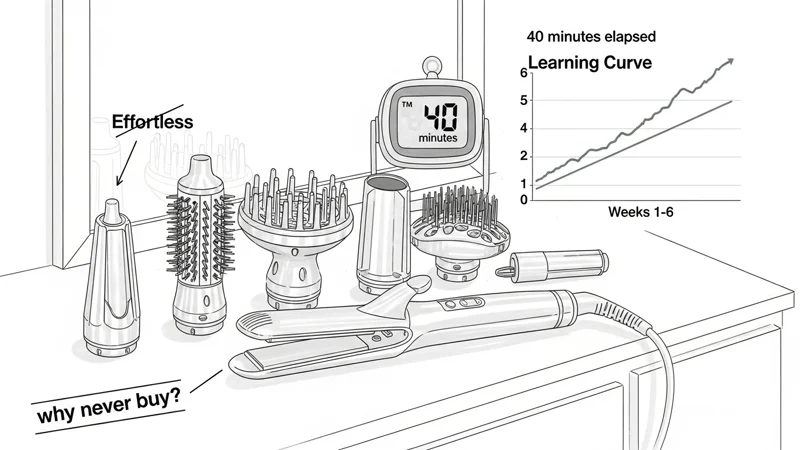
With established technique — not first-week technique, not third-month technique, but the technique of a competent, practiced user — the Airwrap styling routine for shoulder-length, medium-density hair takes 35 to 45 minutes. This includes the pre-drying step (10–15 minutes) and the curling step using the Coanda barrel (25–30 minutes for sectioning and wrapping).
A conventional blow-dryer ($40–80) combined with a standard curling iron ($25–60) achieves comparable results in 20–25 minutes for the same hair type. The Airwrap's lower heat output (around 150°C versus 210–230°C for a standard curling iron) reduces long-term thermal damage. That benefit is real.
But faster?
The 40-minute Airwrap routine is not faster than the 20-minute traditional alternative it positions itself against. The marketing claim of speed is accurate only if your current baseline is longer than 40 minutes — which is possible, but is not the typical user's experience that the marketing implies.
The Attachment Tax
The Airwrap ships with a set of attachments for the core styling modes. Additional attachments — specific barrel sizes, finishing tools, smoothing brushes — are available separately at $40–80 each. The device has a magnetic attachment connection that releases cleanly. Swapping attachments while the barrel is warm is documented as difficult: the mechanism requires a specific grip and rotation that is straightforward when the metal is cool and noticeably less so when it is not.
The barrel swap difficulty when warm is a tactile friction point that accumulates across a daily styling routine. You will swap attachments multiple times per session if you are using the pre-dry step followed by curling. Each swap while the device is operating temperature is a small but consistent inconvenience.
The cord is nine feet, which is sufficient for most bathroom configurations. There is no swivel at the handle. The cord wraps around the device for storage in a way that requires a specific technique to keep neat. This is a minor point and I mention it because the product at $599 is presenting itself at the level of professional equipment, and professional equipment typically solves the cord problem.
The Cord
Nine feet of cord without a swivel joint means the cord torques as you rotate the device during styling. For a device designed to be rotated — the Coanda barrel requires the user to work around the head from multiple angles — the absence of a swivel creates a cord management problem that accumulates across a 35-minute session. The cord does not ruin the experience. It is a consistent small friction on a $599 device where the friction should not be present.
Who This Works For
There is a specific user for whom the Airwrap is proportionate: fine to medium hair, styles daily or near-daily, currently using high-heat tools regularly, and has confirmed through hands-on use (not marketing) that the Coanda curl produces the aesthetic they prefer. For this user, the lower heat output across a year of daily use produces measurably less cumulative damage. The math on thermal damage versus price looks different over 365 sessions than it does at the point of purchase.
For users with thick, coarse, or very curly hair: the Coanda effect will not work consistently. This is in the fine print. Read it before purchasing.
For users who expect a faster routine immediately: the 80% dry prerequisite and the technique learning curve mean the routine will initially be longer, not shorter. "Faster" refers to an eventual state achievable after practice. The marketing does not specify this.
Better Alternatives
| Product | Price | Key advantage over reviewed product |
|---|---|---|
| Dyson Airwrap Multi-Styler | ~$599 | Reviewed — low heat, Coanda curl, 40-minute routine including pre-dry |
| Shark FlexStyle | ~$299 | Same Coanda curling technology at half the price, comparable heat output |
| Revlon One-Step Volumizer Plus | ~$60 | Dry and style simultaneously, no pre-dry step, $539 less |
| BaByliss Nano Titanium Curling Iron | ~$50–80 | Precise temperature control, faster results, no learning curve |
| Quality blow-dryer + ceramic curling iron | ~$100–180 total | Comparable results in 20–25 minutes, $420+ less |
The Shark FlexStyle at $299 uses the same Coanda principle. The physics are identical. The technique learning curve is identical. The heat output is comparable. The price is half. The $300 premium for the Dyson buys the engineering precision, the service network, and the Dyson name. Whether that is worth $300 to a specific buyer is a specific buyer's decision. What it does not buy is a different user experience.
The Information Gap the Marketing Does Not Address
Dyson's marketing identifies a genuine problem — heat damage from conventional styling tools — and presents the Airwrap as the solution. This framing is not wrong. Lower heat is better for hair over time. Coanda curling does produce results without direct plate contact.
The information gap is what the marketing does not say:
That the device requires hair to be 80% dry before Coanda engagement begins, adding a pre-dry step the marketing does not feature. That Coanda works consistently on fine to medium hair and inconsistently on thick or coarse hair — documented in Dyson's own fine print. That "faster" is a claim relative to a longer baseline than most users have. That the total routine time for a competent user is 35–45 minutes, not the quick transformation implied by a 60-second promotional video.
None of this makes the Airwrap a bad device. It makes it a specific device, with specific requirements, that performs well for a specific user profile. The marketing presents it as the universal upgrade. The fine print tells a different story.
Read the fine print first.