 Why
Why
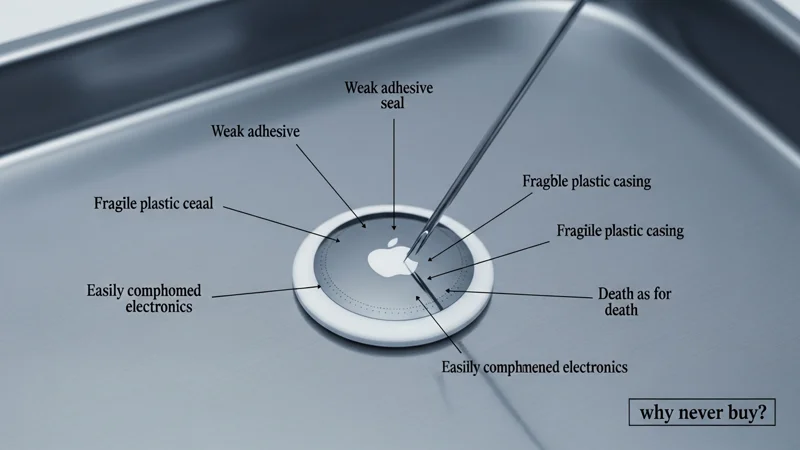
Apple AirTag. COD: systemic dependency on a closed network sold as a standalone product. No foul play detected. The outcome was structural.
Cause of Death
The 4-pack retails at $99. That is $24.75 per disc. Each disc is inert without an Apple device present. Not limited — inert. If you own an Android phone, you cannot set it up. You cannot locate it. You cannot ring it. The Find My network that relays AirTag location data is composed entirely of Apple devices. No Apple devices nearby: no location. The tag does not transmit to any other infrastructure. It broadcasts a Bluetooth Low Energy signal and waits for an iPhone to notice it.
This is not a compatibility footnote. It is the operating principle.
The AirTag also ships with no keyring attachment point. The device is a polished disc. Its most commonly marketed use — attaching to keys — requires a separately purchased holder. Apple sells a Leather Key Ring for $29. Third-party silicone loops run $2 to $5. The product that "helps you find your keys" cannot attach to keys out of the box. That gap between marketing and function is where the autopsy begins.
For a first-time buyer who attaches an AirTag to a bag shared with an Android-using partner: the partner cannot track the bag, cannot ring the tag, and cannot access any interface that acknowledges the tag exists. This is not a rare scenario. Approximately 27 percent of US smartphone users operated Android in 2026. Mixed-platform households describe roughly one in four American homes.
Time of Death
At setup, AirTag functions correctly — within its constraints. Bluetooth pairing takes under two minutes. On iPhone 11 or later, Precision Finding activates: the phone's Ultra Wideband chip communicates directionally with the tag and produces haptic and visual guidance pointing toward the item. I tracked a bag left at a cafe. Location updated three times in twenty minutes as iPhones passed it. That part worked.
The failure timeline is quieter.
Six months in, the first CR2032 battery reads low on one tag. Replacement takes under a minute. No tools. Standard battery, widely available. This is correct design.
By month eight, the workaround most users develop — checking Find My manually before leaving locations rather than relying on passive updates — reveals the tracker's real limitation. Rural use. Mixed-household use. Travel outside the American urban core. In any environment where the surrounding population of iPhones thins out, the tracker's effective range collapses. According to Statcounter, Android holds approximately 72 percent of global mobile OS market share in 2026. The Find My network's density advantage is geographically specific. The packaging doesn't mention which geographies.
Regret accumulates slowly. The tracker works. Then you notice when it doesn't. Then you realize the pattern. — anyway.
Contributing Factors
No GPS chip. AirTag location is reported by whichever iPhone last detected it via Bluetooth. In low-density areas, that report can be 100 to 300 meters off. Adequate for city-block searches. Not adequate for locating something inside a building.
Precision Finding excludes older devices. The directional guidance feature shown in every Apple AirTag ad requires iPhone 11 or newer with UWB hardware. iPhone XR, XS, and earlier models receive only Bluetooth approximation — a distance estimate, no direction. In 2026, those models remain in active household use. The packaging presents one product. It delivers two experiences depending on your phone model.
The stalking problem is documented. AirTags have been used to track individuals without consent. Cases have been filed with law enforcement across the United States. Apple's mitigation: iPhones alert the user when an unknown AirTag has been traveling with them for 8 to 24 hours. Android users receive no automatic alert. They must download Apple's Tracker Detect app manually — which most Android users do not know exists. Firmware updates have adjusted alert timing and added periodic audio from the tag. The structural problem has not changed. A small, easily concealable disc with no GPS and no cellular transmitter remains well-suited to covert placement. That is not a firmware problem.
Ecosystem lock-in is permanent by design. AirTag cannot integrate with Google's Find My Device network, the Tile network, or any cross-platform framework. If you leave Apple's ecosystem, the tags become plastic. Not a risk — a documented consequence of buying into a walled garden that charges admission at every door.
For a traveler going anywhere with Android market share above 50 percent — Europe, Southeast Asia, Latin America, most of the world outside dense American cities — the tracker's effectiveness diminishes with local iPhone density. This is not disclosed on the product page.
For a parent attaching an AirTag to a child's backpack: if the school and surrounding neighborhood have mixed phone demographics, the tag may not update its location for hours while the child is in transit. The passive tracking benefit — the reason to buy — evaporates in environments Apple did not optimize for.
AirTag not updating its location is the most common consequence of this dependency. It is not a defect. It is the product performing as designed in a network that is thinner than the marketing implied.
Precision Finding not working affects every user without iPhone 11 or newer. No workaround. The UWB chip is hardware. It either exists in your phone or it does not.
AirTag making noise on its own — periodic audio alerts added to deter stalking use — affects legitimate owners who forget a tag in their car or luggage. The tag beeps. You did not authorize that. It is Apple's anti-stalking measure generating false positives for the device's intended users. Expected.
Surviving Relatives
Three alternatives exist that do not require ecosystem commitment.
| Product | Price (each) | Platform | Battery Life | Key Advantage |
|---|---|---|---|---|
| Apple AirTag | $24.75 (4-pack) | iOS only | 8–12 months | Precision Finding on iPhone 11+, largest US network |
| Tile Pro | ~$34.99 | iOS + Android | 12 months | Cross-platform, 90 dB speaker, works in mixed households |
| Samsung Galaxy SmartTag2 | ~$27 | Android only | Up to 6 months | UWB precision on Galaxy S21+, SmartThings integration |
| Chipolo ONE | ~$28 | iOS + Android | 12 months | Works on both platforms, louder ring, replaceable battery |
Tile operates a Bluetooth network across both iOS and Android. The Pro model reaches approximately 90 decibels versus AirTag's 60. Smaller US network than Find My. Covers both platform users in the same house.
Samsung's SmartTag2 is the Android-native equivalent. UWB precision finding on Galaxy S21 and newer. Battery life around six months per CR2016. For Android households, this is the structurally correct choice.
Chipolo ONE integrates with both Apple Find My and Google's network. Works across platforms. Louder alert than AirTag. For households that cannot commit to one ecosystem — which describes most households — it is the operationally correct purchase.
For iPhone-only households in iPhone-dense American cities who understand the keyring holder is a separate purchase: AirTag is the best-performing tracker at this price. That qualification is precise. The marketing is not.
Expected.