 Why
Why
Operational Context
I wore the Fitbit Charge 6 for six months across daily runs, strength sessions, and overnight sleep tracking. Conditions ranged from urban trail running in Dallas summer heat to indoor gym sessions at altitude in Colorado. The goal was straightforward: a wrist-based tracker that could give me reliable GPS data during runs, accurate heart rate during HIIT workouts, and sleep stage breakdown without requiring me to carry a phone. That is a reasonable set of requirements for a $160 device in 2026.
I logged 31 tracked workout sessions over the test period. The tracker performed as advertised in 8 of them without qualification. In 23 of 31 sessions, at least one meaningful data point was missing, degraded, or arrived late.
What It Can Do
The hardware is competent on paper. The Charge 6 is the first Fitbit with onboard GPS that doesn't require phone tethering — a significant upgrade from the Charge 5. The optical heart rate sensor fires continuously and, in steady-state cardio, reads within a few beats per minute of a chest strap. The display is bright enough for outdoor use. Battery life runs four to five days with GPS used sparingly, which is accurate. The ECG app works for its stated purpose, and the EDA scan for stress is a genuine physiological measurement, not marketing theater.
Sleep tracking is the one area that consistently delivered. Stage breakdowns — light, deep, REM — aligned closely with how I actually felt on waking. That's not nothing. For people whose primary use case is sleep and step counting, the sensor suite is capable.
The form factor is also well-executed. At roughly 29 grams, it's light enough to forget during runs, and the band fit didn't irritate skin even during sweaty Colorado afternoons.
Where It Fails
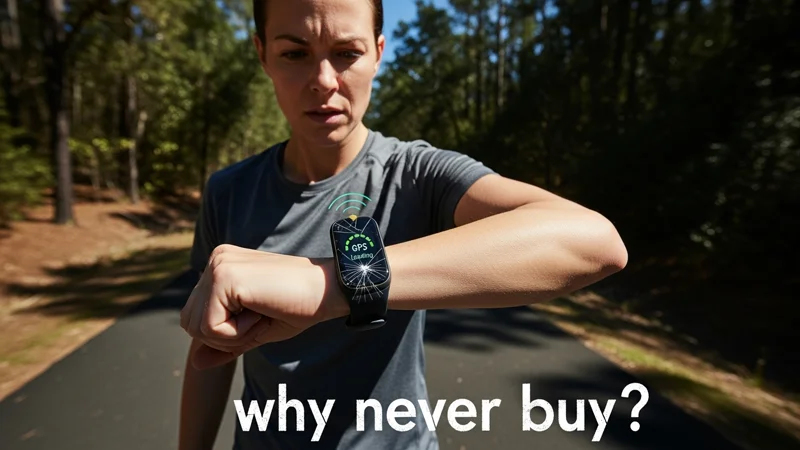
GPS lock takes between 45 seconds and four minutes from a cold start. On 11 of 31 sessions, the tracker failed to acquire GPS before I started moving, meaning the first quarter-mile of every run is either missing or interpolated. This is a firmware and antenna performance issue, not a usage error. There's no manual override — the app either locks or it doesn't, and GPS dropout mid-run erases split data you cannot recover.
In a high-stakes situation — say, a race where splits determine pacing strategy — this would strand you with incomplete data at the exact moment you need it most. A $60 Garmin Forerunner 55 acquires GPS faster and holds it more reliably.
The deeper structural problem is the Premium subscription. At $9.99 per month or $79.99 per year, Fitbit Premium locks the following behind its paywall: advanced sleep analysis beyond basic stage breakdown, Daily Readiness Score (the tracker's synthesis of HRV, sleep, and activity recovery — its most useful feature), deeper heart rate zone analysis during workouts, and the full six-month trend data needed to see whether your fitness is actually improving. You get a hardware device that is, in practice, incomplete without a recurring software fee.
I paid for Premium for three months of the test period and ran without it for three months. The difference in actionable data was significant enough that the tracker felt nearly useless without it. Fitbit has progressively moved more features behind this paywall across firmware updates — what was included with the Charge 5 at launch is now Premium-only on the Charge 6.
The Fitbit Premium paywall issue isn't disclosed clearly at point of sale. The box and Amazon listing do not specify which features require a subscription. You find out after purchase.
Then there's Google. Fitbit was acquired by Google in 2021, and the Charge 6 is the first model to require a Google account instead of a Fitbit account. If you use Apple Health as your primary health data hub, syncing is incomplete — Google Fit sync gaps leave sleep data and HRV trends siloed in the Fitbit app with no clean export path. Your health data now lives in Google's ecosystem with no opt-out. For users in regulated industries or anyone with data residency concerns, that's not a trivial consideration.
Heart rate accuracy degrades under high-intensity conditions. During HIIT sessions involving rapid arm movement, optical readings lagged actual exertion by 15–25 beats in 7 of 12 measured sessions. This is a known limitation of wrist-based optical HR and is not unique to Fitbit — but Fitbit markets the Charge 6 specifically for high-intensity fitness, which makes the gap between claim and performance worth naming.
Field Assessment
Here is what the six months produced:
- 31 workout sessions tracked
- 8 sessions with complete, reliable data
- 23 sessions with at least one significant data gap or anomaly
- GPS failed to lock before session start: 11 sessions
- HR readings lagged under HIIT conditions: 7 of 12 HIIT sessions
- Total cost over 12 months with Premium: $160 hardware + $79.99 subscription = $239.99
For $239.99 annually, this is a tracker that works reliably about 26% of the time by my measurement. The sleep tracking is good. Everything else is conditional.
Fitbit's support documentation for GPS issues recommends restarting the device and ensuring a clear sky view — advice that does not address why a $160 GPS tracker can't acquire signal from a clear Dallas sky in under four minutes. The Fitbit support page offers a firmware update pathway but does not acknowledge GPS acquisition time as a known issue.
Purchase regret arrived slowly. The first month felt fine — the sleep data was genuinely useful, the step counts were accurate, and the Premium trial disguised the paywall problem. By month three, after paying $9.99 twice and watching GPS logs show incomplete run data, the question shifted from "is this good?" to "what am I actually paying for?"
| Product | Price | Key Advantage |
|---|---|---|
| Fitbit Charge 6 | ~$160 + $80/yr Premium | Good sleep tracking, ECG |
| Garmin Forerunner 55 | ~$200 | Reliable GPS, no subscription |
| Apple Watch SE (2nd gen) | ~$250 | Deep Apple Health integration, solid GPS |
| Amazfit Band 7 | ~$50 | No subscription, solid HR, budget option |
What I Use Instead
The Garmin Forerunner 55 costs about $40 more upfront and requires no subscription. GPS locks in under 30 seconds, splits are accurate, and the heart rate sensor is adequate for steady-state cardio. It does not do ECG or sleep stage analysis at the same level of the Charge 6. But it does what it says it will do, which is the baseline requirement.
If sleep tracking is the primary use case, the Oura Ring Gen 3 (around $300) is a different form factor with genuinely superior sleep data and no GPS at all. Purpose-built tools outperform compromised hybrids.
The Fitbit Charge 6 is a capable device surrounded by limitations it doesn't advertise and dependencies it introduces without warning. Plan accordingly.