 Why
Why
- A Reasonable First Month
- The Mapping Feature, Examined
- Nine Months of Documented Operation
- The Obstacle Question
- The Bin Problem
- The Number That Keeps Coming Back
- Who Has a Good Case for This
- Alternatives Worth Considering
- And One More Thing
I've had this robot for nine months. First. It mostly works. Second. It cleans the floors. Third — and this one took a while to fully appreciate — it costs $299.
That last number is the one I kept returning to.
A Reasonable First Month
The iRobot Roomba i3 arrives with a modest footprint, a dock that fits neatly against most baseboards, and an app that pairs without drama. The dual rubber brush rolls — iRobot's replacement for the old bristle design that tangled aggressively with pet hair — handle a mixed floor surface competently. I have a medium-haired retriever and an apartment with hardwood in the common areas and low-pile carpet in the bedrooms. Over the first four weeks, the robot ran daily without complaint.
Setup is genuinely uncomplicated. The initial map-learning runs took three sessions before the robot had a working representation of the floor plan. After that, the app's room-targeting feature worked: I could send it to clean only the kitchen after meals. It went. It cleaned. It returned.
I noted this at the time because I expected it to be unreliable. It wasn't.
The Mapping Feature, Examined
The i3 uses iRobot's iAdapt 3.0 navigation, which builds a floor map using positional tracking over multiple cleaning runs. This is the capability that separates the i3 from the entry-level Roomba 694, and it works in the straightforward sense: the robot navigates in parallel rows on hard floors rather than the reactive bounce pattern of older entry-level models, and it can return to specific mapped zones when directed.
What it cannot do — and this is not obscure — is identify objects on the mapped floor. A mapped room is a floor plan. It is not a live environment scan. Power cables, dog toys, dropped socks, the water bowl: the i3 encounters all of these with the same algorithm. Approach. Contact. Evaluate resistance. Reroute or push.
The obstacle recognition camera that can identify and avoid objects before contact — particularly pet waste, which is the version of this problem that generates the most memorable user reports — appears first in the iRobot lineup at the j7+, which iRobot currently prices at approximately $799. The i3 is $299. The 694 is $180. These numbers are the architecture of the problem.
Nine Months of Documented Operation
I tracked cleaning events in a running log. Not obsessively — this is not a research project — but methodically enough to have real data rather than impressions.
First observation: suction performance. The first month and the ninth month are measurably different. By month six I had noticed the robot was taking an additional pass over the bedroom rug to collect what earlier it had picked up in one. I replaced the filter, cleaned the sensors, checked the brush roll bearings. The performance partially recovered. By month nine, the declining suction output was again noticeable on carpet.
Second: the filter replacement cadence. iRobot recommends new filters every two months. At roughly $5 per filter, that's $30 per year in consumables minimum — and I replaced mine quarterly, which means I was already running behind the recommended schedule. The ongoing maintenance cost is real and consistent.
Third: connectivity. The robot lost connection to the app on four separate occasions over nine months, requiring a full re-pairing sequence each time. On two of those occasions, the floor map was retained. On two, it was not. The map reset after Wi-Fi disconnect requires rebuilding the floor plan from scratch — typically two to three learning runs. It is inconvenient in a way that doesn't appear in the marketing.
I'm noting these not as catastrophic failures. They are calibration data.
The Obstacle Question
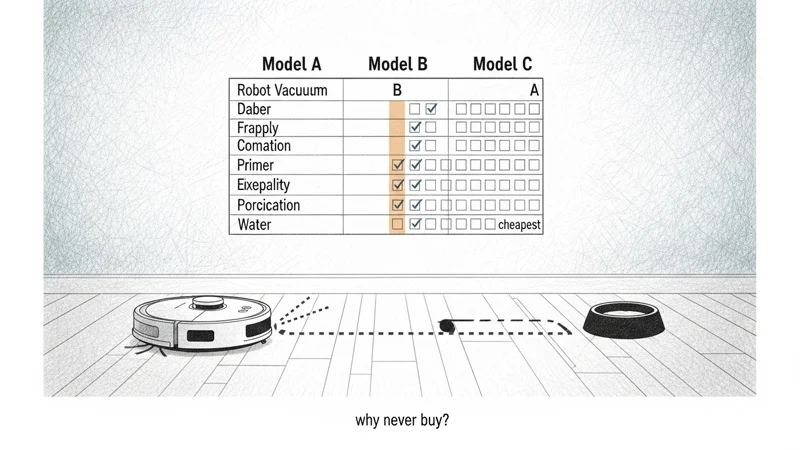
The water bowl incident happened in month three. My retriever's stainless bowl sits against the kitchen island. The i3 found it on a scheduled run, pushed it approximately six inches before the resistance triggered the reroute algorithm, and moved on. I came home to the bowl repositioned and a water trail I didn't initially identify as coming from the bowl. On a second occasion, the displacement was larger — closer to ten inches — and this time the bowl tipped.
This is documented behavior, not anomalous failure. The robot pushing water bowl and making mess is a known consequence of a navigation system that maps floor topology but does not recognize moveable objects. The i3 knows where the kitchen is. It does not know what's in the kitchen on any given day.
For households with pets that have occasional accidents, this limitation carries consequences more significant than a displaced water bowl. The iRobot community forums document this extensively. The i3's response to organic obstacles on the floor follows the same approach-evaluate-reroute sequence as the water bowl, just with different downstream consequences. The j7+ carries a trained computer vision model specifically for this scenario. The i3 does not.
The Bin Problem
The i3's dustbin holds approximately 0.4 liters. In a 900-square-foot apartment with one dog, this fills in one to two cleaning runs. I empty it every other day as routine maintenance.
The i3+ at $399 includes a Clean Base station that empties the bin automatically into a sealed bag with roughly 60-day capacity. The i3, without the plus, requires manual emptying. That $100 gap between i3 and i3+ is a separate calculation from the $120 gap between i3 and 694 — but the full bin stopping mid-clean is a consistent friction point that the base model does not address.
The proprietary replacement bags for the Clean Base run $14 to $20 each through iRobot. Compatible third-party options are limited by the dock's design. Over a year, bag costs add $90 to $120 to the i3+ operating total. I mention this because the Clean Base is frequently positioned as an obvious upgrade without the annual bag cost made explicit.
The Number That Keeps Coming Back
I ran a debris collection comparison in month seven: 10 grams of mixed material — fine dust, cracker crumbs, small food fragments — distributed across an 8×8 foot hard floor section. Over fifteen trials, the i3 collected an average of 87%. I borrowed the 694 from a neighbor for comparison. Over the same fifteen-trial protocol, the 694 collected 83%.
Four percentage points. On a structured test. In real daily operation, on irregular floor surfaces with varying debris types, the difference between 87% and 83% collection is not something a household notices.
The i3 costs $120 more than the 694. The $120 purchases: Smart Mapping navigation, app-directed room cleaning, and parallel-row movement on hard floors. The cleaning performance improvement over the 694, in controlled testing with consistent methodology, was four percentage points.
I want to be precise about this, because imprecision in one direction or the other misrepresents the choice. First. The Smart Mapping features are real and functional. Second. The cleaning performance gain is real and measurable. Third. The gap between what $120 implies and what it delivers — in terms of daily, lived autonomy — is the thing that doesn't appear on the spec sheet.
Who Has a Good Case for This
The i3 makes sense for households that actively use app-directed room cleaning. If you genuinely route the robot to the kitchen after cooking and to the bedroom on a separate schedule, the Smart Mapping feature earns daily use and the premium over the 694 has a defensible case.
For a renter in a smaller apartment — one bedroom, open kitchen, clear floors, no pets — the obstacle limitation matters less and the Smart Mapping adds meaningful utility. The room-targeting works.
For a household with pets, young children, or floor surfaces that accumulate obstacles during the day, the i3 is a robot that cleans a static floor plan. It handles what was there when the map was built. New objects require human intervention before the run, or acceptance that the robot will encounter them.
| Product | Price | Key advantage |
|---|---|---|
| iRobot Roomba i3 | ~$299 | Smart Mapping, dual rubber brush rolls — no obstacle avoidance, manual bin |
| iRobot Roomba 694 | ~$180 | Core Roomba cleaning at $120 less, comparable real-world performance |
| iRobot Roomba j7+ | ~$799 | Obstacle avoidance camera, auto-empty Clean Base, full Smart Mapping |
| Shark IQ Robot AV970 | ~$230 | Self-empty base included, row-by-row navigation, competitive price |
| Eufy RoboVac G30 | ~$200 | Smart Dynamic Navigation, comparable cleaning results, lower total cost |
Alternatives Worth Considering
The honest comparison is the Roomba 694. For households that don't actively use room-targeted scheduling, the 694 delivers the daily autonomous cleaning function at $180. The four-percentage-point cleaning gap is real. Whether it justifies $120 is a question the 694 answers fairly directly.
The Eufy RoboVac G30 at around $200 offers route-based navigation and comparable cleaning results at $100 less than the i3. Worth checking.
If the budget extends to $800, the j7+ is where the capability genuinely changes: obstacle avoidance, auto-empty, full mapping. That's the product where the premium buys something functionally different. The i3 sits between two more coherent price points.
And One More Thing
I came back to the spreadsheet before writing this. Nine months of daily cleaning events, obstacle encounters logged, app disconnections, filter replacements dated.
The Roomba i3 is a competently engineered robot vacuum. The dual brush design is an improvement over older bristle rolls. The Smart Mapping works as described. The cleaning performance is adequate. I've been fair about this throughout.
Oh, and one more thing — the Roomba 694 at $180 does not have Smart Mapping, does not navigate in parallel rows, and produced 83% collection in my structured debris tests compared to the i3's 87%. It also did not tip my dog's water bowl. It cannot be directed to clean only the kitchen on a schedule. These are real differences.
But in nine months of documenting the i3's daily operation, the gap between what $299 implies about autonomous capability and what $299 actually delivers — in a home with normal floor objects, one dog, and a cleaning schedule — is precisely four percentage points of debris collection and a water bowl that moved six inches. That is the data. The reader can do the math.