 Why
Why
- First Impressions, Fairly Given
- The Seven Functions, Examined in Turn
- What the Display Actually Shows
- Seven Months of Logged Sessions
- The Slow Cooker Discrepancy
- The Gasket Situation
- Who Has a Genuine Case for This
- Alternatives Worth Considering
- Worth Noting
I want to say at the outset that I came to the Instant Pot Duo 7-in-1 with an open mind and a legal pad. I had resisted buying one for three years on the grounds that I already owned a stovetop pressure cooker, a slow cooker, and a rice cooker, and that consolidating three appliances into one seemed like a trade I understood the terms of. Eventually my slow cooker died — the dial's contact plate failed — and I thought: this is the moment. The Instant Pot Duo 6-quart model retails around $100. I bought it on a Tuesday in October and had it on the counter by Thursday.
I have been timing things ever since.
First Impressions, Fairly Given
The physical product is well-made. First. The stainless steel inner pot is thick and even, heavier than I expected, and the handles are positioned in a way that makes carrying it from the base to the sink genuinely comfortable. Second. The lid locks with a solid quarter-turn click that communicates confidence in its own mechanism. Third. The control panel is straightforward — the buttons are large, the display is readable without glasses, and the preset functions are labeled without ambiguity.
The safety architecture is also real. The lid cannot be removed while the pot is under pressure. The float valve — the small silver pin that rises when pressurization is complete and falls when pressure has dissipated — is a visible indicator that eliminates the guesswork that older stovetop pressure cookers required. The steam release valve, which the user manually turns from "sealing" to "venting" for quick release, works exactly as described. I tested the safety features specifically in the first two weeks, because I have a professional habit of testing the failure modes before I trust the normal operation.
The product does not fail in obvious ways. This is worth establishing early.
The Seven Functions, Examined in Turn
The Instant Pot Duo advertises seven functions on the front panel: Pressure Cook, Slow Cook, Rice, Steam, Sauté, Keep Warm, and Yogurt. I tested all seven over seven months.
Sauté is the function I used most and liked most. The ability to brown aromatics directly in the pot before pressure cooking eliminates a separate pan, which is a genuine convenience that I had underestimated. The temperature is not restaurant-level — the element cycles, producing an intermittent sizzle rather than consistent high heat — but for softening onions, browning ground meat, or building a sauce base, it is adequate. This was the function that kept me from returning the unit in month two.
Rice comes out correctly. Not better than a $30 dedicated rice cooker. Correctly.
Steaming works. Keep Warm works. Yogurt requires specific cultures and a comfort level with an eight-hour unattended fermentation cycle; I attempted it twice and ate the results on both occasions without incident.
I will address Slow Cook and Pressure Cook separately, because those are the functions around which the product's value proposition is built, and both require more than a sentence.
What the Display Actually Shows
This is the observation that took me seven months to frame precisely, so I'll spend the time it deserves.
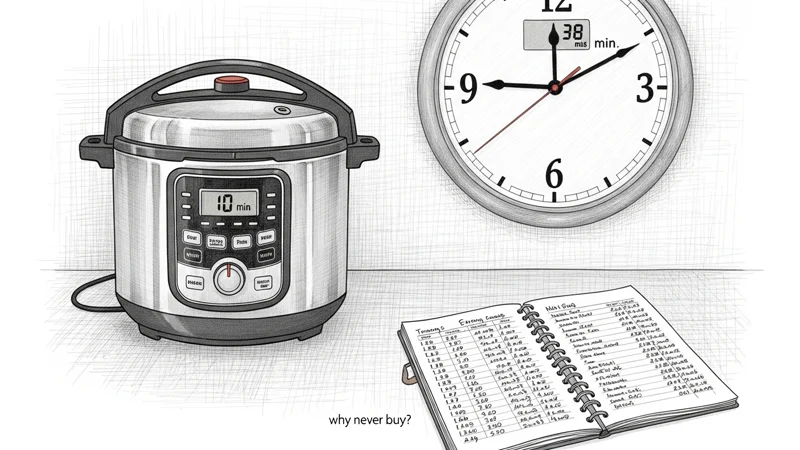
When you program the Instant Pot Duo for a pressure cooking session — say, chicken thighs, 12 minutes at high pressure, a common weeknight approach — you press the Pressure Cook button, confirm the time and pressure level, and press Start. The display shows "On." Then the display begins counting down.
It does not count down from 12 minutes.
It counts down from whatever time is required for the pot to reach full pressure. During this phase — which the Instant Pot documentation and virtually every recipe card calls "preheating" or "coming to pressure" — the display shows the remaining preheat time, not the cook time. The 12-minute cook timer has not started. It begins only after the float valve rises, the pot locks into full pressure, and the unit transitions from preheat to cook mode.
For a 6-quart pot filled with 2 pounds of chicken thighs, 1 cup of broth, and aromatics at refrigerator temperature: coming to pressure takes 15 to 22 minutes in my logged sessions. The median, across 43 sessions over seven months, was 17 minutes.
After the 12-minute cook cycle completes, pressure must be released. Quick release — turning the steam valve to venting — takes 3 to 5 minutes. Natural release — leaving the valve sealed and allowing pressure to dissipate on its own, which certain dishes require for texture — takes 15 to 25 minutes.
So: 17 minutes to pressure, 12 minutes at pressure, 4 minutes quick release. Total: 33 minutes from pressing Start to lifting the lid for a dish the recipe calls "12 minutes." This is not an anomaly. This is the arithmetic. The preheat time adding 15–25 minutes per session applies to every pressure cooking session, with no exceptions. Fill the pot more; preheat extends. Start with refrigerator-cold ingredients; preheat extends further.
I am not suggesting the Instant Pot lies. The cook time is the cook time. I am noting that "12 minutes" appears on the display, on the recipe card, on the YouTube tutorial thumbnail, and in the companion cookbook — and that "12 minutes" does not communicate the full session duration to a first-time buyer making a weeknight dinner calculation.
That is the observation. It took 43 timed sessions to state it precisely.
Seven Months of Logged Sessions
I kept a log. Date, recipe, fill weight, starting ingredient temperature, preheat time, cook time, release method, release time, total session duration. Not because I had a hypothesis — I began keeping records the week after I found myself eating dinner at 8:47 PM when I had expected to eat at 8:00 PM.
Some findings from 43 sessions:
The fastest complete pressure-cook session I logged was 27 minutes: a small batch of hard-boiled eggs, 5 minutes at pressure, 1-cup water, quick release. A stovetop pot of boiling water does hard-boiled eggs in 12 minutes from cold, no preheat required.
The longest preheat I logged was 24 minutes: a pot roast, 3.5 pounds of chuck, cold from the refrigerator, 1.5 cups beef broth. Total session duration including the 60-minute cook time and 20-minute natural release: 104 minutes. The conventional oven braise for the same cut runs 2.5 to 3 hours. The Instant Pot was meaningfully faster. This is precisely the use case where the product's advantages are real.
For dishes requiring natural release — pot roast, beans, tough cuts — the natural release taking 15–25 minutes adds substantially to the session. In my log, 19 of 43 sessions required natural release. Those sessions averaged 22 minutes of release time.
First observation: for dishes with conventional cook times under 45 minutes, the stovetop is often competitive or faster when total session time is calculated. Second observation: for long braises, dried legumes, and tough cuts, the time savings are genuine and significant. Third observation — and this one surprised me — the number of weeknight recipes that fall into the second category is smaller than the Instant Pot's marketing implies.
The Slow Cooker Discrepancy
I had hoped the Instant Pot would replace the slow cooker I had lost. It does not do this in the way I expected.
The Instant Pot Duo's slow cooker function runs hotter than conventional slow cookers at equivalent labeled settings. This is well-documented in cooking communities and has been measured by multiple food publications. On the "Low" setting, the Duo reaches temperatures that a Crock-Pot or Hamilton Beach would classify as high or medium-high. Recipes written for conventional slow cookers — which represent the vast majority of slow cooker recipe libraries — require time and temperature adjustments to produce correct results in the Instant Pot.
I made pulled pork twice: once on the Duo's "Low" setting for 8 hours, once on my neighbor's Crock-Pot for 8 hours on low. The Duo version was overcooked. The meat was not inedible — it was dry in a way that pulled pork should not be — and the correct Duo approach, I learned from community forums, is to run it on the "Less" sub-setting for 6 to 7 hours. There is no "Less" labeled on the front panel. It appears only on the display after you navigate into the settings.
If your primary use case for purchasing the Instant Pot Duo is slow cooking: test carefully. The slow cooker running hotter than conventional settings means your existing recipe library needs adjustment. A dedicated slow cooker at $30 runs at the temperatures those recipes were written for.
The Gasket Situation
The sealing ring — the silicone gasket seated in the lid that creates the pressure seal — absorbs food odors. A pot roast on Monday leaves a faint pot roast note in the ring that affects rice on Wednesday. A curry leaves an aroma detectable for four to six subsequent sessions. Washing the ring with dish soap and water does not fully remove embedded food volatiles; baking soda paste and vinegar are more effective, requiring 20 minutes of additional cleaning.
The practical solution — and the one the Instant Pot community arrived at before I did — is to own two sealing rings: one designated for savory dishes, one for neutral or sweet preparations. Replacement rings cost $8 to $12 through Instant Pot's official site. Many users purchase a second ring within the first month. This is an expected and somewhat predicted additional cost that the $100 price does not disclose.
The ring must be removed, inspected, and cleaned after every use. It must be reinstalled correctly — seated fully around the lid's inner groove — before the next session. Incorrect seating produces a "Lid" error and prevents pressurization. I had this error four times in seven months, all from user installation error, all resolved in under a minute. I am noting it not as a product failure but as an ongoing maintenance rhythm that the product requires and that most reviews do not dwell on.
Who Has a Genuine Case for This
Households that regularly cook tough cuts of meat or dried legumes: This is where the Instant Pot Duo earns its price unconditionally. Beef short ribs that require 2.5 hours of conventional braising become a 90-minute total operation including preheat and release. Dried chickpeas, unsoaked, from raw to cooked in 45 minutes total. For users who cook these ingredients weekly, the time savings accumulate into something genuinely meaningful over a year.
One-pot households prioritizing minimal cleanup: The sauté-then-pressure-cook workflow eliminates the separate browning pan. That is a real dish, a real convenience, and a real daily benefit for households sensitive to kitchen cleanup overhead.
Buyers who have read the preheat arithmetic before purchasing: Not a demographic the marketing cultivates, but the users who will be most satisfied. If you know that "12 minutes" means 33 minutes from Start to lift-lid, you have calibrated expectations. Calibrated expectations produce satisfaction.
Anyone expecting weeknight time savings on dishes under 30 minutes of conventional cook time: The preheat time applies to every session. For a chicken breast dish at 10 minutes of pressure — 17 minutes preheat, 10 minutes at pressure, 4 minutes quick release — the total is 31 minutes. A covered skillet on the stovetop is competitive.
Alternatives Worth Considering
| Product | Price | Key advantage over Instant Pot Duo |
|---|---|---|
| Instant Pot Duo 7-in-1 (6 qt) | ~$100 | Reviewed — solid pressure cooker, slow cooker runs hot, preheat time not in recipes |
| Crock-Pot 7-Quart Manual Slow Cooker | ~$30 | Runs at temperatures that slow cooker recipes were actually written for, $70 less |
| Ninja Foodi 9-in-1 Pressure Cooker | ~$200 | Adds air-fry lid, pressure cook and crisp in one pot — fewer appliances for users willing to pay |
| Breville Fast Slow Pro | ~$250 | Clearer timing communication, better slow cooker temperature accuracy, premium construction |
| Presto 8-Qt Stovetop Pressure Cooker | ~$45 | Faster pressurization (stovetop heat source), no electronics to fail, $55 less |
For the slow cooking use case: the Crock-Pot at $30 is the correction, not the compromise. The Instant Pot Duo's slow cooker function requires recipe adaptation. The Crock-Pot is what the recipes were written for.
For multi-function kitchen consolidation at a higher budget: the Ninja Foodi at around $200 makes a more coherent case — the air-fry lid is a genuine addition, and the pressure cooking function is well-regarded in current testing.
Worth Noting
I went back through my log one more time before writing this. Forty-three sessions. First. The pressure cooking function works correctly in every case. Second. The build quality has shown no degradation after seven months of regular use. Third. I have not experienced any safety events.
And then — one more thing worth noting — the product is called Instant Pot.
I have spent some time with that name. "Instant" is a word that carries a specific implication about time. The Instant Pot Duo, as I have documented across 43 sessions over seven months, requires a median of 17 minutes before any cook time begins. The fastest complete session in my log — hard-boiled eggs, minimal fill, quick release — was 27 minutes. I can do hard-boiled eggs on the stovetop in 12.
The name is aspirational. The preheat timer is literal. The gap between those two things is, I believe, the specific piece of information that a buyer deserves to have before they decide whether $100 represents a correct trade for the cooking outcomes this appliance actually produces.
I noted it mildly. Worth checking.